
 English
 Tiếng Việt
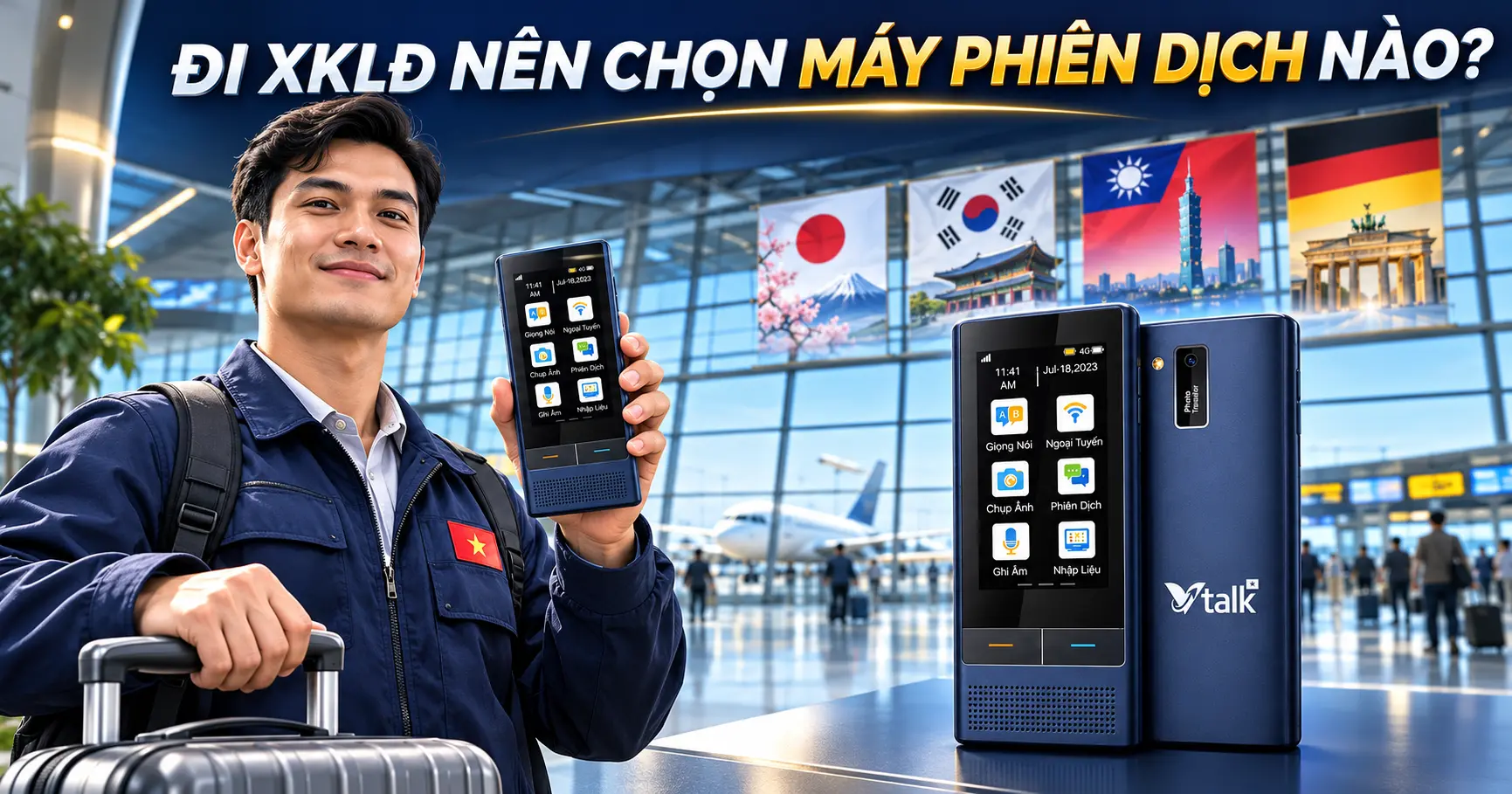

Key Summary:Overseas workers should choose a translation device that supports the exact Vietnamese – destination language pair, features a suitable offline translation mode, and is easy to operate in...
- Distribution Certification:Genuine devices by the systemMayphiendich.net(12-month 1-to-1 replacement warranty).
- Hands-on Experience:Customers can personally test the 138+ languages translation feature at226 Duong Lang (Hanoi) or137 Hoa Hung (District 10, HCMC)before purchasing.
- Technical Support:Lifetime software installation and offline translation data upgrades via Hotline:0386.001.001 - 0974.051.444.
Guest workers should choose translation devices that accurately support the Vietnamese – destination language pair, feature an appropriate offline translation mode, and are easy to operate in daily life. Especially when working in Japan, South Korea, Taiwan, or Germany, noise-canceling audio recording capabilities, internet connectivity, and technical support policies are also critical factors to consider.
Language barriers are one of the most common challenges when starting work abroad. Even after studying foreign languages before departure, many people still face obstacles understanding instructions from managers, communicating with colleagues, or handling daily life situations.
A suitable translation device can help workers proactively communicate, ask for clarification on things they don't understand, and express their own needs. However, not all devices support the same language pairs, possess offline translation capabilities, or operate effectively in factory environments.
The article below will guide you on how to choose a translation device for guest workers, compare popular device lines, and suggest models worth considering based on country, usage needs, and budget.
1. Why should guest workers prepare a translation device?
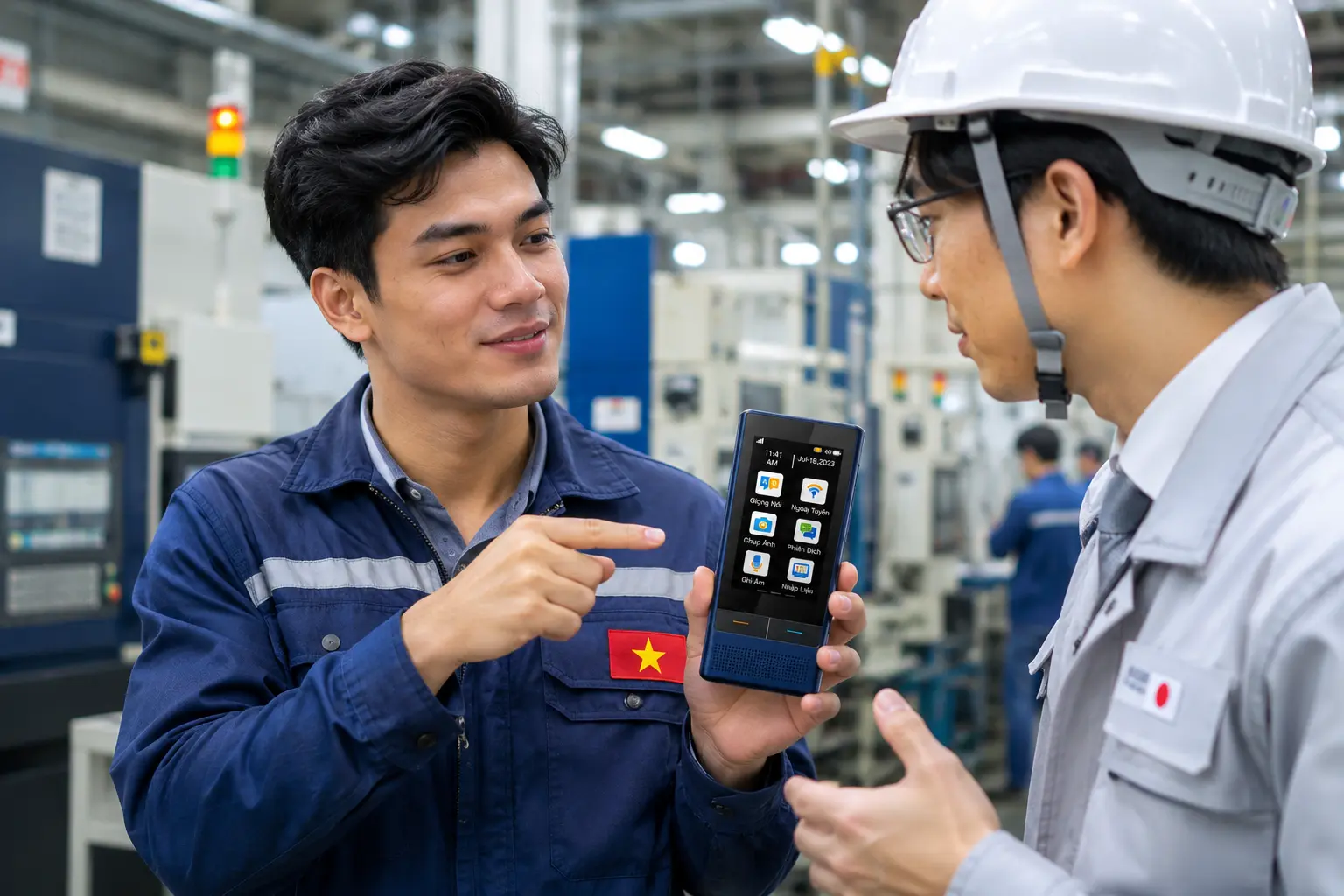
A translation device is a helpful communication tool for workers who are not yet fluent in a foreign language. The device helps convert speech between two languages, displays content for users to verify, and facilitates conversations in various everyday situations.
Difficulties communicating with foreign managers and colleagues
During the initial working period, failing to fully understand a manager's requirements can lead to misunderstandings or incorrect task execution.
Even with prior language training, workers may still struggle with fast speaking paces, regional accents, or company-specific terminology.
Translation devices help users proactively ask again, verify instructions, and reduce reliance on Vietnamese-speaking coworkers.
Language barriers in factory and workshop environments
Communication ability in industrial environments is heavily affected by noise from machinery, conveyor belts, public address systems, and multiple people speaking simultaneously.
These are also conditions that can degrade the voice recognition efficiency of translation devices.
Particularly with instructions containing numerical data, units of measurement, technical terms, or safety procedures, workers need to reconfirm the details with the person in charge rather than relying solely on automated translation.
Inconvenience in daily life, shopping, and administrative procedures
Beyond work, workers also need to communicate when:
Shopping, asking prices, and using services.
Asking for directions, finding transportation.
Handling administrative or banking procedures.
Communicating at hospitals and pharmacies.
Resolving issues at their accommodation.
Translator devices can help express basic needs in these situations, especially when there is no acquaintance to help.
How do translator devices support workers?
Depending on the model, translator devices can provide the following functions:
Two-way voice translation: Converts speech from Vietnamese into other languages and vice versa.
Offline translation: Uses language pairs supported by the device when there is no Internet connection.
Image translation: Recognizes and translates text in photos.
Text display: Helps both parties verify the recognized information.
Audio playback via speaker: Convenient for face-to-face communication.
However, translation devices do not completely replace foreign language proficiency. For content related to occupational safety, health, or legal documents, a qualified professional is required to confirm the translation.
2. Which translation device should migrant workers choose based on the destination country?
Priority should be given to the correct Vietnamese – destination country language pair rather than just focusing on the total number of advertised languages. A device supporting 138 online languages does not necessarily have the capability to translate all those language pairs offline.
Translation devices for migrant workers going to Japan
Japan is a market where many Vietnamese people work in fields such as manufacturing, mechanical engineering, construction, food processing, and services.
Japanese uses many polite expressions, honorifics, and technical terms. Therefore, when choosing a device, you should check:
Two-way Vietnamese – Japanese translation capability.
Support for the Vietnamese – Japanese pair offline if needed when there is no internet connection.
Ability to recognize sentences with honorifics.
Text display mode to review translated sentences.
Quick operation when needing to ask or respond to managers.
VTalk Go Pro 2026 is one of the device lines announced by Mayphiendich.net to have 19 offline languages, including two-way translation between Vietnamese and Japanese, Korean, Chinese, and English.
Buyers should directly test the offline mode on the delivered device version to ensure it meets practical needs.
Translation devices for migrant workers going to South Korea
Korean has multiple levels of honorifics, forms of address, and sentence structures depending on the communication context.
When working in South Korea, the translation device needs to adequately support situations such as communicating with managers, asking about shift information, reporting errors, or requesting re-instruction of procedures.
Priority should be given to devices capable of two-way Vietnamese – Korean translation, supporting text display, and featuring simple operation.
If needed for use without the Internet, you should directly test the Vietnamese – Korean pair in offline mode, and check its ability to recognize common workplace expressions.
Translator devices for guest workers in Taiwan
In Taiwan, Mandarin is widely spoken alongside the Traditional Chinese writing system.
When choosing a translator device, attention should be paid to local voice recognition, Traditional Chinese display support, and two-way translation between Vietnamese and Chinese.
A notable point is that Mandarin is not the same as Taiwanese (Taiwanese Hokkien). Not every device that supports Chinese can translate local dialects.
If working in an environment where Taiwanese is frequently used, buyers need to check specifically for this language's support.
Translator devices for guest workers in Germany and Europe
For workers in Germany or European countries, the ability to translate long sentences, specialized terms, and maintain a stable Internet connection are priority factors.
German has relatively complex sentence structures and compound words. Therefore, it is advisable to test sentences with multiple clauses and work-related content before purchasing.
A device supporting 4G SIM, eSIM, or Wi-Fi can help maintain connectivity to use online translation mode.
If planning to use it without an Internet connection, it is necessary to check specifically for the Vietnamese – German offline pair. The fact that a device has German in its offline list is not enough to confirm two-way Vietnamese – German translation support.
Translator device selection guide by country
| Country | Priority Language | Features to Check |
|---|---|---|
| Japan | Vietnamese – Japanese | Two-way translation, offline, honorific recognition |
| South Korea | Vietnamese – Korean | Conversation translation, voice recognition, offline |
| Taiwan | Vietnamese – Chinese | Taiwanese accent, traditional Chinese, two-way translation |
| Germany | Vietnamese – German | Long sentence translation, Internet connection, offline package if available |
| Other countries | Vietnamese – local language | Correct language pair and actual connectivity conditions |
3. Important criteria when buying a translation device for overseas labor
To choose a suitable device, buyers should simultaneously evaluate translation capability, connectivity, design, and support policies instead of only comparing the number of languages or prices.
Supports the exact language needed
This is the most important criterion when buying a translation device.
Ask the seller to directly test both translation directions, for example, Vietnamese to Japanese and Japanese to Vietnamese.
For work environments with many regional accents, check the device's ability to recognize native pronunciation.
Supports Vietnamese offline translation and the correct language pair
Offline translation allows the device to process supported languages without an Internet connection.
This feature is useful in places with weak signals, areas without Wi-Fi, or when mobile data is not yet available.
However, 19 offline languages does not mean that all 19 languages can translate reciprocally between each other.
Before purchasing, turn off Wi-Fi and mobile data, select the exact language pair you need, and test the translation both ways.
Fast and easy-to-use two-way conversation translation
A suitable device should feature a clear interface, simple operation, and support displaying the recognized text.
For first-time translator device users, easily distinguishable functional buttons and the ability to broadcast translations through the speaker will make communication much more convenient.
Translation speed may vary depending on sentence length, language, connection quality, and audio recording conditions.
Microphone and speaker suitable for noisy environments
Voice pickup capability directly affects recognition and translation quality.
A device equipped with dual microphones, noise-canceling technology, and an external speaker can help enhance the experience in certain environments.
However, you should not assume that the device can accurately recognize every statement in a manufacturing workshop.
When testing, check the recognition capability at a normal conversation distance and under suitable background noise conditions.
Good battery life, compact design
Workers often need to carry the device for long periods. Therefore, the device should have an ergonomic size, an appropriate weight, and a battery life that meets usage needs.
Battery capacity measured in mAh reflects only part of the usable time. Actual battery life also depends on the screen, network connection, and translation frequency.
You should also consider USB-C charging capability or the option to use a power bank.
Features Wi-Fi, SIM, or eSIM for online translation needs
An Internet connection allows you to use the online translation features and languages supported by the device.
Models with a 4G SIM or eSIM can be convenient when users do not yet have a stable Wi-Fi connection abroad.
Before purchasing, make sure to confirm the supported countries, data plan validity period, data allowance, and any additional costs if applicable.
Warranty policy and technical support
Workers using devices abroad may face difficulties when in-person warranty service is needed.
Therefore, it is advisable to choose a seller with clear policies and remote guidance support.
You should ask in advance about the warranty period, software update procedures, troubleshooting solutions, and return/exchange conditions.
4. Should you buy a handheld translator, translation earbuds, or AI glasses?
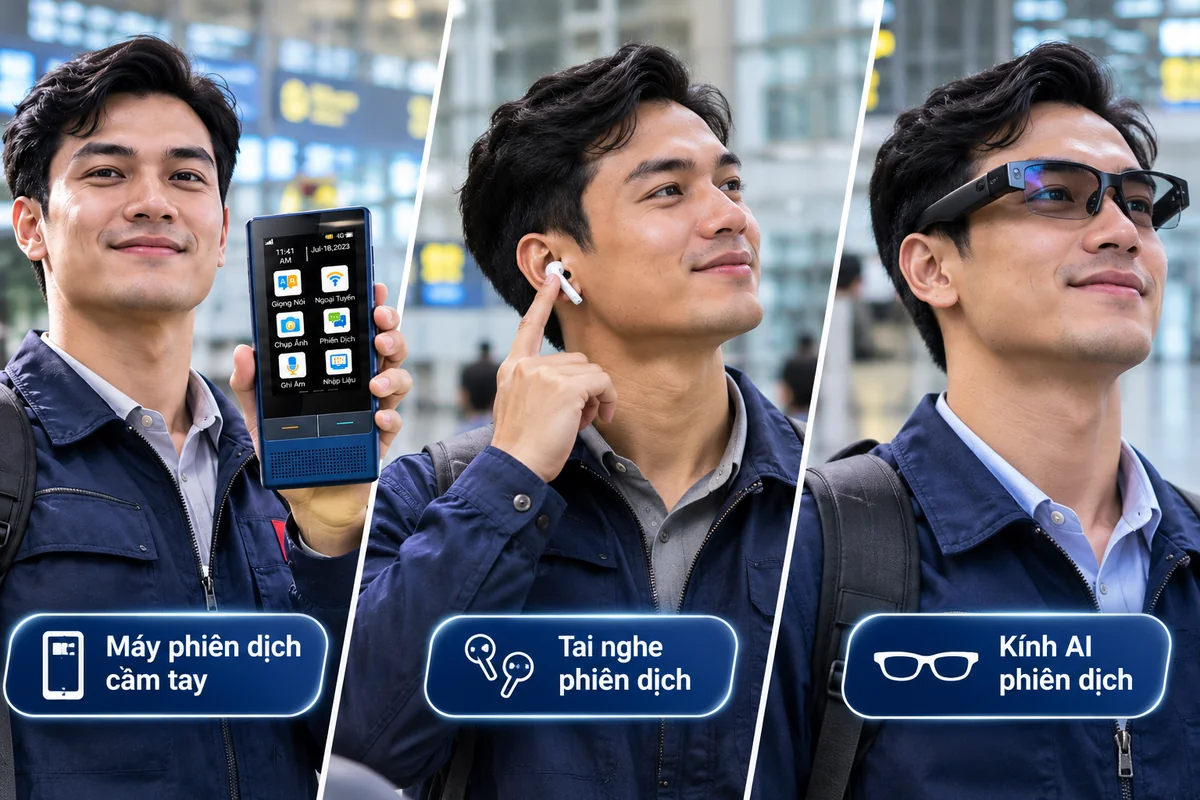
Handheld translators are often an easy-to-use choice for new migrant workers, especially when direct communication with managers or service staff is needed.
Meanwhile, translation earbuds and AI glasses offer different experiences, suitable for specific use cases.
Handheld translator
Handheld translators feature a text display screen and an external speaker to play translations.
Advantages:
Easy to show the screen to the other person to verify.
Can play translations directly through the speaker.
Some models support SIM/eSIM and offline translation.
No need for the other person to wear earbuds.
Limitations: Users must hold the device while communicating, which is inconvenient when working with both hands.
Two-way translation earbuds
Translation earbuds are suitable for extended conversations or situations requiring continuous translated listening.
Some models have a mode that allows the other person to hear the translation through the phone's speaker without wearing earbuds.
However, devices like the Timekettle WT2 Edge need to be used with a smartphone and a compatible app.
In addition, workers need to comply with regulations regarding earphone use in factory environments.
AI Translation Glasses
Some AI glasses feature built-in displays, allowing users to read translated content directly within their line of sight.
The advantage of these devices is reducing interaction with handheld screens in certain situations.
However, not all AI glasses have a display or support translation subtitle display. Usability also depends on the model, software, and workplace safety requirements.
You can learn more about AI translation glasses.
Comparison table of handheld translators, earbuds, and AI glasses
| Criteria | Handheld translator | Translation earbuds | AI glasses with display |
|---|---|---|---|
| Face-to-face communication | Convenient | Depends on mode | Depends on model |
| Hands-free communication | Limited | More convenient | More convenient |
| Translation display | On the device screen | Usually via app | On the glasses screen if available |
| Play translation for others | Via speaker | Via headphones/phone | Depends on model |
| Offline translation | Depends on language pair | Depends on model and app | Depends on model |
| Suitable for beginners | Accessible | Requires getting used to | Requires learning features |
| Workplace safety requirements | Requires checking | Requires checking | Requires checking |
Selection tips: If you frequently have short exchanges with multiple people, a handheld device is the preferred option. If you need to listen to translations during long conversations, earbuds may be more suitable. AI glasses should be chosen when users genuinely need display capabilities and have confirmed compatibility with the work environment.
5. Top translation devices worth considering for migrant workers
Below are four devices selected for comparison based on the following criteria: Vietnamese language support, offline translation capability, Internet connectivity, design, and listed price.
VTalk Go Pro 2026 – Translation device supporting offline Vietnamese and eSIM
VTalk Go Pro 2026 is a handheld translation device featuring a 2.8-inch IPS screen, 2GB RAM, 16GB internal storage, and a 3,000 mAh battery.
According to published specifications, the device supports:
138 online languages.
19 offline languages, including Vietnamese.
Photo translation for over 56 languages.
4G eSIM and Wi-Fi connectivity.
Dual microphones supporting noise cancellation.
USB-C charging.
According to information published on Mayphiendich.net, VTalk Go Pro supports two-way offline translation between Vietnamese and English, Chinese, Japanese, and Korean.
This is an important consideration for workers who need to communicate in conditions without an Internet connection.
The device is also introduced with a 2-year global eSIM data promotion. Users should check the country coverage and terms of use for the data package before departing abroad.
Listed price: 3,990,000 ₫.
Suitable for: Those who need a compact handheld translator supporting offline Vietnamese and mobile Internet connectivity options.
Points to consider: The 2.8-inch screen is relatively small compared to 4-inch models.
VTalk Pro+ 2026 – Large-screen translation device, 4,000 mAh battery
VTalk Pro+ 2026 is equipped with a 4-inch screen, 2GB RAM, 16GB internal storage, and a 4,000 mAh battery.
According to published specifications, the device supports:
138 online languages.
19 offline languages, including Vietnamese.
Photo translation in over 60 languages.
4G SIM, VSIM, Wi-Fi, and Hotspot connectivity.
4-inch screen.
4,000 mAh battery.
Micro USB charging port.
The large screen allows users to easily check recognized text and show translated content to the person opposite them.
The device supports Vietnamese offline translation according to product specifications. However, buyers should check the specific list of offline language pairs to ensure it meets their needs in the destination work country.
Listed price: 5,990,000 ₫.
Suitable for: Those who prioritize a large screen, high battery capacity, and multiple connectivity options.
Points to consider: Larger size than the Go Pro series and uses a Micro USB charging port.
VTalk Plus+ 2026 – Compact translator supporting 19 offline languages
VTalk Plus+ 2026 features a 4-inch IPS screen, 2GB RAM, 16GB storage, and a published weight of around 113 g.
Key specifications include:
137 online languages.
19 offline languages, including Vietnamese.
Photo translation in 44 languages.
4G and Wi-Fi connectivity.
Dual microphones with noise cancellation support.
4-inch IPS screen.
2,000 mAh battery according to listed specifications.
USB-C charging port.
VTalk Plus+ is suitable for those who want a handheld translator with a large screen while still remaining convenient to carry around.
For offline translation needs in Vietnamese – Japanese, Vietnamese – Korean, or Vietnamese – Chinese, you should test the exact language pairs directly on the device.
Listed price: 4,990,000 ₫.
Suitable for: People who prioritize a compact device with a 4-inch screen and advertised offline Vietnamese support.
Points to consider: Need to cross-check the battery capacity of the delivered version as the information on the product page is inconsistent.
Timekettle WT2 Edge – Translation earbuds for two-way conversation
Timekettle WT2 Edge is a line of translation earbuds that supports conversation via the Timekettle app on smartphones.
According to manufacturer information, the device supports:
43 online languages and 96 accents.
13 offline language pairs.
Simul, Touch, Speaker, and Listen modes.
Dual microphones and Vector Noise Cancellation technology.
Connects to smartphones via Bluetooth.
Battery life of about 2–3 hours per charge and about 10–12 hours combined with the charging case, depending on usage conditions.
WT2 Edge is suitable for people who frequently engage in extended conversations or prefer listening to translations via earbuds.
However, Vietnamese is not among the 13 offline language pairs announced by Timekettle.
This means users need an Internet connection to translate Vietnamese on WT2 Edge.
Listed price at Mayphiendich.net: 7,900,000 ₫.
Suitable for: People who need translation earbuds for conversations and have a stable Internet connection.
Points to consider: Does not support offline Vietnamese translation and requires use with a mobile app.
Comparison table of translation devices for migrant workers
| Model | Online translation | Offline translation | Connectivity | Battery | Price |
|---|---|---|---|---|---|
| VTalk Go Pro 2026 | 138 languages | 19 languages, including Vietnamese; announced pairs: Vietnamese – Japanese/Korean/Chinese/English | 4G eSIM, Wi-Fi | 3,000 mAh | 3.990.000 ₫ |
| VTalk Pro+ 2026 | 138 languages | 19 languages, including Vietnamese; pair list needs verification | 4G SIM, VSIM, Wi-Fi | 4,000 mAh | 5.990.000 ₫ |
| VTalk Plus+ 2026 | 137 languages | 19 languages, including Vietnamese; pair list needs verification | 4G, Wi-Fi | 2.000 mAh according to the spec sheet | 4,990,000 ₫ |
| Timekettle WT2 Edge | 43 languages | 13 pairs, Vietnamese not supported | Via smartphone | 2–3 hours/charge | 7,900,000 ₫ |
Which model should you choose?
If your budget is around 4 million VND and you prioritize a handheld device with offline Vietnamese translation, the VTalk Go Pro is a choice worth considering.
If you prefer a larger screen and a higher battery capacity, the VTalk Pro+ is suitable for comparison. The VTalk Plus+ is another option for those who prioritize a compact design and a 4-inch screen.
The Timekettle WT2 Edge is better suited for conversations requiring earbuds, but it is not the right choice when offline Vietnamese translation is a mandatory requirement.
6. Can a translation device be used while working in a factory?
Translation devices can support basic communication in a factory, but they should not be used as the sole source of information for safety instructions, technical specifications, or equipment operating procedures.
Voice recognition capability in noisy environments
Noise from machinery, conveyor belts, and multiple people talking simultaneously can cause the device to miss or misinterpret content.
Dual microphones and noise cancellation technology can improve voice pickup, but they do not completely eliminate the impact of ambient noise.
When communication is needed, choose a safe area with lower noise levels and keep the device at an appropriate distance from the speaker.
Translating general instructions and everyday conversations
Translation devices can support short sentences such as:
"I don't understand this request yet."
"Could you please repeat that?"
“I need assistance.”
“When does the shift start?”
“Can you write the instructions on paper?”
For sentences containing data, part numbers, units of measurement, or technical requirements, be sure to verify the recognized content and translation.
Cases where you should not rely entirely on the device
Do not rely solely on automated translation to carry out:
Operating instructions for hazardous machinery.
Procedures involving electricity, compressed air, and chemicals.
Technical specifications and tolerances.
Occupational safety guidelines.
Decisions related to contracts, health, or legal rights.
In these cases, confirmation from a manager, safety officer, or qualified interpreter is required.
7. How much does a translation device for overseas labor cost?
The devices featured in this article have listed prices ranging from 3.990.000 ₫ to 7.900.000 ₫, depending on design, connectivity options, and translation features.
Under 4 million VND segment
At a price point under 4 million VND, users can consider the VTalk Go Pro 2026 with a listed price of 3.990.000 ₫.
The device is worth considering if you want a compact handheld unit with advertised offline Vietnamese support and eSIM connectivity.
4 to 6 million VND segment
This segment includes two models from the list:
VTalk Plus+ 2026: 4,990,000 ₫.
VTalk Pro+ 2026: 5.990.000 ₫.
Both feature a 4-inch screen and are advertised to support 19 offline languages, including Vietnamese.
The notable differences lie in the declared battery capacity, design, and connectivity options.
Segment over 7 million VND
Timekettle WT2 Edge is listed at 7,900,000 ₫.
This is a suitable choice for users who need earphone-based translation, frequently hold conversations, and are capable of using mobile apps.
However, a higher price does not necessarily mean it better meets the needs for offline Vietnamese translation.
Should you buy a cheap translator?
You can choose a lower-priced device if it meets three requirements: it supports the right language pairs, has suitable connectivity options, and comes with a clear warranty.
Buyers should not rely solely on the advertised number of languages while overlooking offline translation capabilities or actual handling performance.
You can check the translator price list to compare other options.
8. Tips for using translators before and after departing abroad
Preparing the device before the trip helps workers be more proactive when arriving abroad, especially during the initial period when they are not yet familiar with the environment and Internet access at their destination.
Check and download offline language packages
Before departing, check the software version and download the necessary language packages.
Then, turn off Wi-Fi and mobile data to test the offline mode.
It is recommended to test both translation directions with practical sentences related to work and daily life.
Check Internet connection and eSIM
If the device supports eSIM or virtual SIM services, verify the supported countries, activation conditions, and data validity period.
In addition, prepare backup connection options such as Wi-Fi at your accommodation or a local mobile SIM.
Practice speaking concisely and clearly
To improve voice recognition:
Speak in short sentences with clear meaning.
Avoid speaking multiple sentences at once.
Reduce background noise if possible.
Check the recognized text.
Ask the other person to repeat when the translation is unclear.
Prepare specialized vocabulary and basic communication phrases
Besides using the device, workers should learn vocabulary related to their occupation in advance.
You can prepare a list of common phrases such as requesting leave, reporting equipment errors, asking about work schedules, or requesting instructions again.
Important terms should be verified with foreign language teachers, instructors, or reliable resources.
9. Where to buy reliable translation devices for overseas workers?
When purchasing a translation device for overseas use, choose a supplier that provides clear product information, allows trials, and offers a transparent warranty policy.
Criteria for choosing an authentic device retailer
A vendor worth considering should publicly disclose:
Model name and technical specifications.
Price, return policy.
Warranty period.
Offline translation capability.
SIM/eSIM usage conditions if any.
User guide and software updates.
In particular, you should request a live demo of the exact language pair you need instead of just watching pre-recorded introductions.
Check warranty, origin, and technical support
Before making payment, check the device condition, serial number (if any), accessories, and warranty terms.
Be sure to clarify how to contact support from abroad and the procedure for handling issues if the product develops a defect.
Advice on choosing a device by country and budget
To receive advice tailored to your needs, please provide three pieces of information:
The country you are preparing to work in.
Estimated budget.
Usage environment: factory, construction, restaurant, nursing, or daily living.
From there, you can choose a device that supports the right language pair, necessary features, and a suitable budget.
View translation devices that support offline Vietnamese
10. Frequently Asked Questions about Translation Devices for Overseas Workers
Can I use a translation device if I go to Japan without knowing Japanese?
Yes. Vietnamese – Japanese translation devices can help workers communicate in basic situations. However, the device cannot completely replace learning Japanese, especially for specialized work content and occupational safety.
Does a translation device require the Internet?
It depends on the mode of use. Online translation requires the Internet, while offline translation uses language packs supported by the device. Before purchasing, it is necessary to check the exact offline language pair you need to use.
Can an offline translator translate Japanese?
Yes, if the device supports the corresponding language pair. For example, VTalk Go Pro is announced by Mayphiendich.net to support two-way offline translation for Vietnamese – Japanese, Vietnamese – Korean, and Vietnamese – Chinese. For other models, you should directly check the language pair list.
Can the device hear and translate regional accents?
The ability to recognize regional accents depends on the device, language, and usage environment. For distinct dialects, it is necessary to test practically before buying rather than assuming the device can recognize all pronunciations.
Can the device translate slang and specialized terminology?
The device can provide partial support, but specialized terms, slang, and abbreviations may be mistranslated. For critical content, users should cross-reference with documentation or consult an expert.
Can translator devices be used in factories?
They can be used to support basic communication in areas where personal devices are permitted. Automated translation should not be used as the sole basis for machine operation instructions or workplace safety.
Should you buy a translator device or use a smartphone?
Smartphones have the advantage of availability and numerous translation apps that support offline mode. Dedicated translator devices may be more convenient in terms of operation, speakers, microphones, or connectivity depending on the model. You should choose based on actual needs rather than assuming one option is always more accurate.
Should you buy a translator device before going abroad?
You should prepare before the trip to have time to check languages, update software, activate connectivity, and get familiar with the operations. This also helps resolve issues early if the device is unsuitable or encounters errors.
Conclusion: Which translator device should you choose when going abroad for work?
A suitable translator device needs to support the right language pair, connectivity conditions, and actual communication needs of workers.
For newcomers to Japan, South Korea, Taiwan, or Germany, handheld translators are an option worth considering thanks to their display screens and external speakers, which are convenient for face-to-face communication.
VTalk Go Pro is suitable for those who prioritize a compact device, Vietnamese offline support, and eSIM. VTalk Pro+ is ideal for users wanting a large screen and high-capacity battery, while VTalk Plus+ is another option in the mid-range segment.
Timekettle WT2 Edge is better suited for earphone conversation needs, but does not meet the requirement for Vietnamese offline translation.
Before making a decision, request a trial with the exact language pair, check offline translation performance, and confirm overseas support policies.
Need advice on choosing a translator device by country and budget?
Contact 0386.001.001 – 0386.002.002 for consultation, checking specifications, and selecting the appropriate device before departure.
Q&A & Real Experiences at Mayphiendich.net
📍 Where to experience and purchase genuine translation devices and AI glasses in Hanoi & HCMC?
You can visit directly to test devices and experience translation capabilities in over 138 languages at the two genuine authorized showrooms ofMayphiendich.net:
- Hanoi Showroom: No. 226 Lang Street, Thinh Quang Ward, Dong Da District, Hanoi (Hotline:0386.001.001 - 0974.051.444).
- HCMC Showroom: No. 137 Hoa Hung Street, Ward 12, District 10, HCMC (Hotline:0386.002.002).
🛡️ What are the warranty policy and quality commitments?
100% of products distributed by Sarina Trading Investment Company Limited are brand new, genuine, and factory-sealed. Warranty policy:12 months, 1-to-1 exchange within 30 daysif technical defects occur, along with lifetime software update support.
✈️ Can the device translate when traveling abroad without WiFi or 4G?
High-end translation devices such as Atalk Plus and Travis Touch Go at Mayphiendich.net feature built-in offline data packages for 14 to 17 of the most popular languages, ensuring responsive and accurate translation even on airplanes or in areas without cellular coverage.