
 English
  Tiếng Việt
 Learning foreign languages has long been an essential skill, opening up many new opportunities in work, travel, and global communication. However, not everyone has the time or ability to easily learn a new language. The advent and development of translation devices has changed the landscape, not only supporting instant language translation but also becoming a powerful tool to make the foreign language learning process more effective. So, how can you make the most of translation devices in learning foreign languages? This article will provide detailed answers.
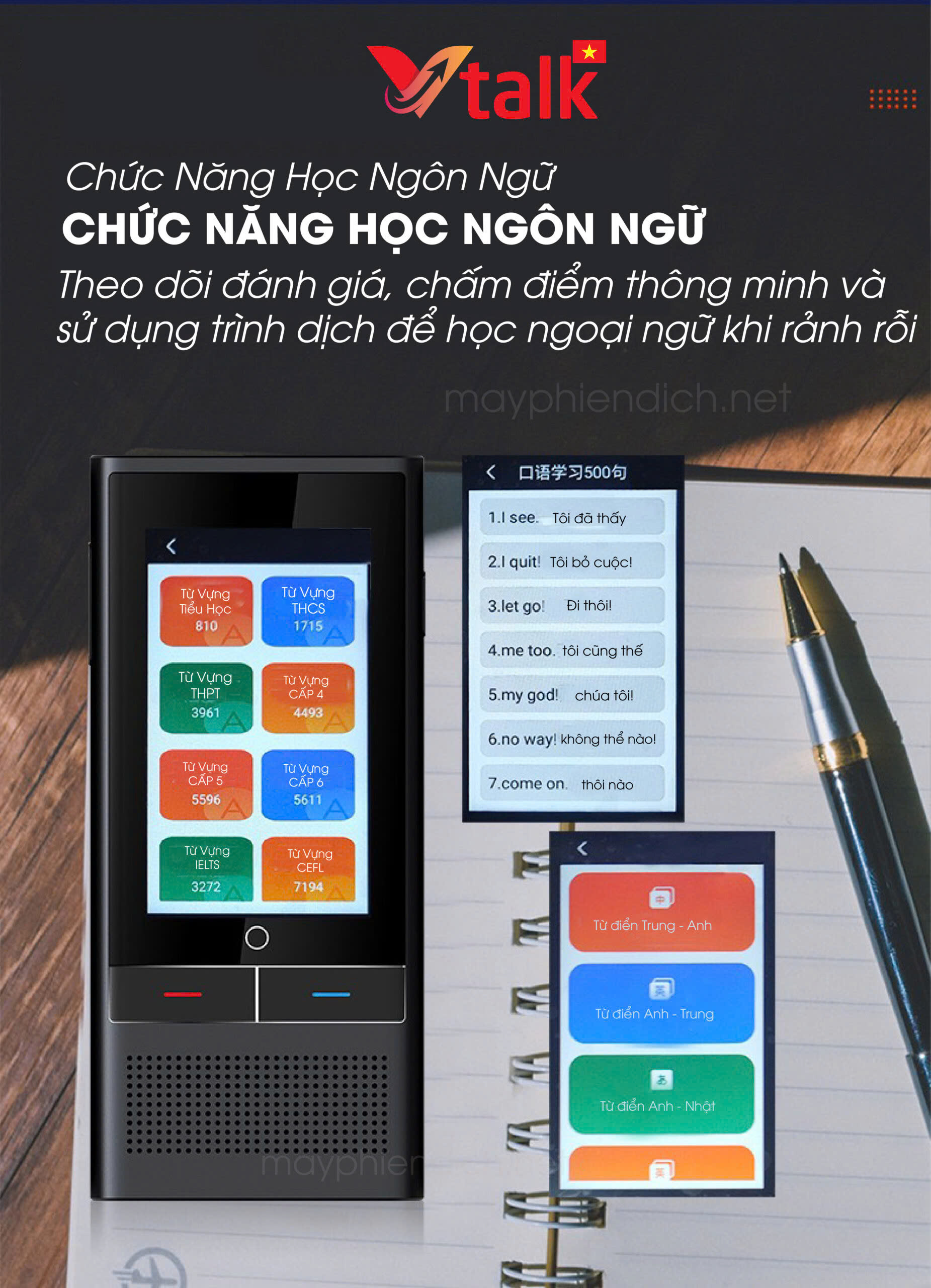
VTALK is one of the best language learning devices available today
1. What is a Translation Device? Its Role in Language Learning
A translation device is a device or software application that uses artificial intelligence (AI) technology to translate languages in real-time. Not only useful in daily communication, translation devices also bring great value in learning, especially for self-learners of foreign languages.
Key Roles in Language Learning
- Translate Vocabulary and Phrases: Provides quick translations, helping learners easily look up new words.
- Improve Listening Comprehension: Translation devices can read and pronounce accurately, supporting the improvement of listening skills.
- Instant Feedback: Helps learners receive immediate feedback when practicing communication.
- Grammar Support: Some advanced translation devices also explain grammar and sentence structures.
2. Benefits of Translation Devices in Language Learning
Save Time
Translation devices help you look up and understand the meaning of new words or complex sentences in a short amount of time, instead of having to flip through dictionary pages or search online.
Improve Pronunciation
One of the biggest difficulties when learning a foreign language is pronunciation. Modern translation devices have the ability to pronounce correctly, helping you imitate and practice accurately.
Increase Communication Speed
Thanks to translation devices, learners can apply language knowledge to real-life situations faster. You can use the device to communicate with native speakers without fear of language barriers.
Learn in Context
When communicating in daily life, translation devices provide accurate translations based on context, helping you understand and remember vocabulary better.
3. Ways to Utilize Translation Devices in Foreign Language Learning
Use for Vocabulary Lookup
Translation devices can replace traditional dictionaries, helping you quickly look up vocabulary. For effective learning, save new words and review them regularly.
Practice Listening Skills
- Listen to Standard Pronunciation: Listen to the pronunciation from the translation device and compare it with your own pronunciation.
- Listen to Automatic Translation of Sentences: Practice by speaking a Vietnamese sentence and listening to its translation into the language you are learning.
Practice Speaking with a Translation Device
Most modern translation devices have speech recognition capabilities. You can say a sentence and let the device translate it, then compare to improve your speaking skills.
Integrate into Daily Learning Activities
- In the Classroom: Use the device for quick lookups when studying in class.
- In Daily Work:Use a translation device when working with foreign documents or communicating with international partners.
Learn Through Integrated Applications
Some modern translation devices integrate language learning applications, providing exercises, tests, and skill-building lessons.
4. Best Translation Devices for Language Learning
Currently, there are many translation devices on the market specifically designed for language learning. Below are some prominent devices:
IFLYTEK
- Supports multiple languages.
- Features voice, image, and text translation.
Kazuna
- Fast and accurate translation with over 74 languages.
- Integrates AI to improve translation context.
Langogo
- Automatically updates language data.
- Capable of native-standard pronunciation.
iFLYTEK Smart Translator
- Real-time translation with high accuracy.
- Supports grammar and pronunciation learning.
5. Limitations and Solutions When Using Translation Devices
Limitations
- Not Absolutely Accurate:In some cases, translation machines may not correctly understand the context.
- Dependency on Technology:Over-reliance on translation machines can reduce natural learning ability.
- Language Limitations:Some machines do not support rare languages.
How to Fix
- Combine translation machines with traditional learning methods such as reading books, listening to music, and watching movies.
- Use translation machines as a support, not as a complete dependency.
- Always check and verify translations from multiple sources.
6. The Future of Translation Machines in Language Learning
Translation machines are constantly being improved to meet the ever-increasing demands in learning and communication. In the future, we can expect:
- Deep Contextual Automatic Translation:Understanding intonation, emotions, and meaning in communication.
- Integrated Personal Learning AI:Translation machines can analyze each individual's learning style to suggest appropriate methods.
- Support for Rare Languages:Further development of less common languages.
Conclusion
Translation machines are powerful support tools, making language learning easier and more enjoyable than ever before. However, to maximize their potential, you need to combine them with traditional learning methods and have a clear study plan. With the support of this advanced technology, language learning is not just a challenge but also an exciting journey. Start using translation machines today to expand your communication abilities and explore the world!